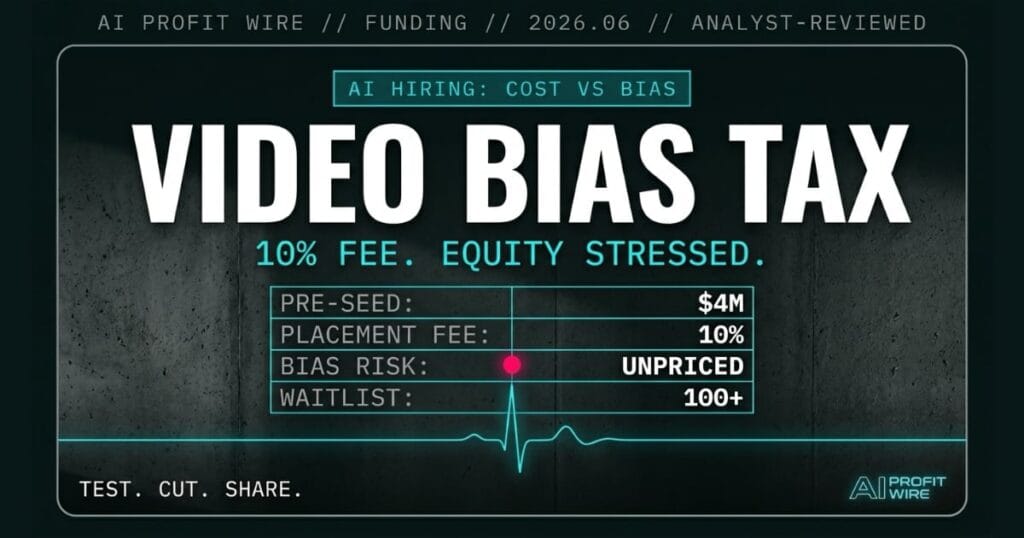
Could lower recruiting costs with a 10% placement fee versus traditional headhunters, though employers must weigh the efficiency against potential video-introduced bias.
What’s Fika Jobs and what changed?
Fika Jobs is a Stockholm-based startup that raised $4M in pre-seed funding to build a video-first hiring platform where AI agents interview candidates.
The platform generates personalized questions from a candidate’s LinkedIn profile, conducts roughly 10-minute video interviews powered by Google’s Gemini models, and auto-edits responses into short video clips for employer browsing. More than 100 companies are on the waitlist and over 50 have tested the platform, including Plenty Labs, SICS.ai, Kognity, and Rebtel.
Fika Jobs replaces the resume submission with an AI-mediated video profile that employers discover rather than candidates applying to each role individually.
What’s the evidence behind Fika Jobs?
The $4M round was led by Luminar Ventures with participation from Alliance VC and King co-founders Sebastian Knutsson and Riccardo Zacconi, the duo best known for creating the hit mobile game Candy Crush.
The platform is free for job seekers. Employers pay no upfront cost but are charged 10% of a candidate’s first-year salary upon successful hire, which Fika notes is below the 20% to 30% placement fees typical of traditional recruiters and headhunters. Early access opens this week for candidates, with a broader public launch expected this fall and initial focus on Sweden before international expansion.
The pricing model shifts recruiter risk from fixed upfront costs to contingent success fees, but only if the platform can deliver qualified hires at volume.
How does Fika Jobs affect day-to-day operations for small businesses?
For small business owners, Fika Jobs offers a lower-cost alternative to traditional headhunters with a 10% placement fee versus 20% to 30%.
The platform targets early-career professionals and non-traditional candidates whose potential may not appear on paper, which could expand talent pools for roles where resume signals are weak. However, video-first hiring introduces documented bias risks: employers see race, age, gender, physical appearance, and accent before evaluating qualifications, which contradicts the trend toward blind resume screening in some organizations.
Small business owners should weigh recruitment cost savings against the compliance and fairness risks of video-based first impressions.
You post a job for a line cook and get 60 resumes that all read the same: “fast-paced environment,” “team player,” “attention to detail.” You can’t tell who will actually survive a Friday dinner rush from a PDF. So you call 15 people, schedule 8 interviews, 3 no-show, and 2 of the remaining 5 freeze the moment the grill backs up. The entire process cost you 12 hours of management time and you’re back to posting the same ad.
That’s the problem Fika Jobs is attacking, and the pitch is seductive: let AI surface the grit and communication that paper hides. But The Truth-Seeker in this signal lives in the tension between efficiency and equity. The same video that reveals a candidate’s composure under pressure also reveals their skin color, their accent, and whether they look like the person doing the hiring. The 10% placement fee is genuinely cheaper than the staffing agency. The bias risk isn’t priced into the invoice, and no AI model is going to disclose that trade-off for you.
What’s the final verdict on Fika Jobs?
Fika Jobs is an early-stage bet on AI-mediated video replacing resume-based hiring, with a cost structure that undercuts traditional recruiters by half or more.
The 10% placement fee and zero upfront cost lower barriers for small businesses that lack dedicated HR staff or recruiter relationships. The documented bias risks of video profiles, however, mean employers must implement their own safeguards rather than relying on the platform to provide them.
Monitor Fika Jobs for cost-conscious hiring, but don’t adopt it without internal guardrails until it proves bias-safe at scale.
Source: TechCrunch AI
