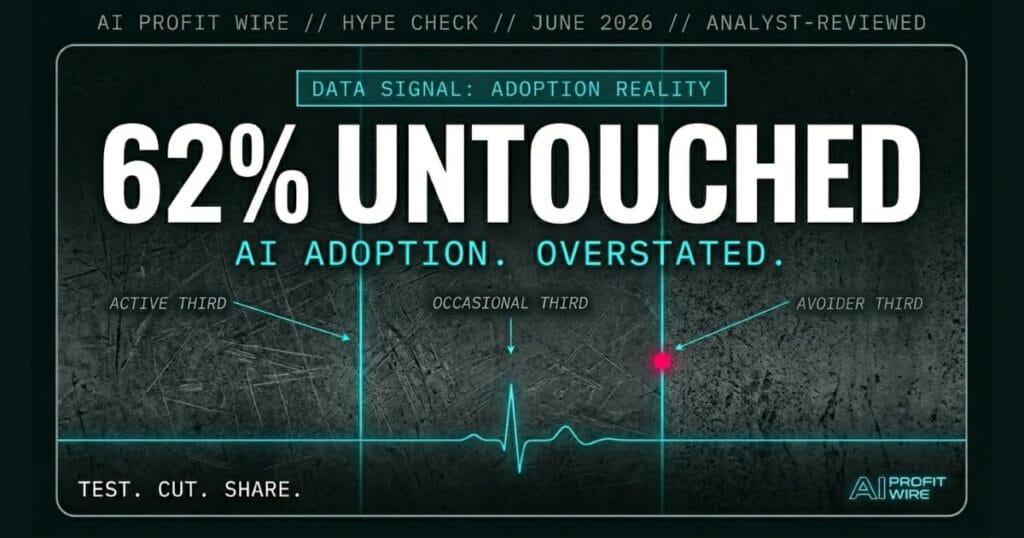
Small businesses should not feel pressured to adopt AI for everything; customer bases are heavily split, meaning human-centric and privacy-focused alternatives remain highly viable differentiators.
What is the actual state of AI adoption and what changed?
The mainstream narrative claims near-universal AI adoption, but data from Microsoft telemetry, Datos desktop tracking, and Gallup’s 2026 Gen Z survey shows a deeply fragmented reality split into three roughly equal groups.
Microsoft’s anonymized telemetry and Datos data show approximately one third of working-age adults actively using AI, one third using it occasionally, and one third avoiding it entirely, with 62% of desktop devices visiting AI tools zero times per month. Gallup’s 2026 survey of 1,572 Gen Z respondents confirms the pattern: 22% use AI daily, 29% weekly, 11% monthly, 20% every few months, and 19% never use it at all.
AI adoption is a three-way split, not a universal wave, and the data comes from three independent sources converging on the same conclusion.
What is the evidence behind AI adoption stalling?
Microsoft telemetry, Datos desktop visit data, and Gallup’s probability-based panel survey all point to the same structural fragmentation: roughly one third actively using AI, one third occasionally, one third avoiding it, with the avoider segment showing rising negative sentiment rather than stalling on the path to adoption.
Gallup’s 2026 data shows anger about AI rose 9 percentage points year-over-year among Gen Z, while excitement dropped 14 percentage points and hopefulness fell 9 points. Among Gen Z workers, 48% now believe AI risks outweigh workplace benefits, up from 37% the prior year. Top consumer concerns identified include job replacement (42%), privacy violations (35%), and misinformation (33%), with AI’s net positive societal rating at just +8%, barely above social media’s +7%.
The negative sentiment trajectory is the most operationally significant data point: the non-adopters aren’t waiting to convert, they’re actively moving away.
How does AI adoption fragmentation affect day-to-day operations for small businesses?
Small business owners can stop treating AI as a mandatory customer expectation and start treating it as a market segment. With 62% of desktops showing zero AI tool engagement and 48% of Gen Z workers believing AI risks outweigh benefits, building an AI-first customer experience strategy assumes a customer behavior pattern that the majority of the market doesn’t exhibit. See how adoption signals are tracking week over week at the live archive of AI adoption and consumer behavior signals for small business owners.
The business implication runs in two directions. The active third of the market wants AI-powered speed and personalization, and serving them well requires genuine AI integration. The avoider third represents an underserved segment actively looking for human-centric, privacy-forward alternatives, and that positioning is currently unoccupied in most markets. The occasional middle third shifts based on context and trust, making them the most responsive to clear, honest communication about when AI is and isn’t in use.
Human-centric service and privacy-first policies are now active competitive differentiators, not nostalgic holdovers from a pre-AI era.
A delivery fleet manager watching her drivers report back from routes knows the gap between dashboard metrics and ground truth. The dispatch system shows 100% on-time delivery, but three customers called to complain about damaged packages that the system never flagged. She pulls the drivers, checks the cargo straps herself, and finds frayed webbing on one truck that passed its last automated inspection. The telemetry said everything was fine. The actual delivery said otherwise. That’s what this AI adoption data is: the telemetry of industry hype saying one thing while actual consumer behavior, the calls, the refusals, the 62% of desktop devices that visited AI tools zero times last month, says another. That 62% isn’t a rounding error. It’s the equivalent of three out of five trucks in your fleet running empty routes while the dashboard insists they’re fully loaded. The businesses that win aren’t the ones with the flashiest AI announcements. They’re the ones that look past the telemetry and serve the customers who never showed up on the dashboard.
What is the final verdict on AI adoption reality versus hype?
The claim that everyone is using AI for everything is demonstrably false and operationally dangerous for small businesses that set strategy based on it.
With one third of consumers actively avoiding AI tools, anger about AI rising 9 percentage points year-over-year among Gen Z, 48% of Gen Z workers believing risks outweigh benefits, and AI’s net positive societal rating barely above social media, the AI-first positioning assumption alienates more of the addressable market than it attracts.
Audit where AI actually improves your operations versus where it satisfies internal pressure to look current, and build explicit human and privacy-forward alternatives for the segment the data confirms is actively choosing them.
Source: gabrielweinberg.com
