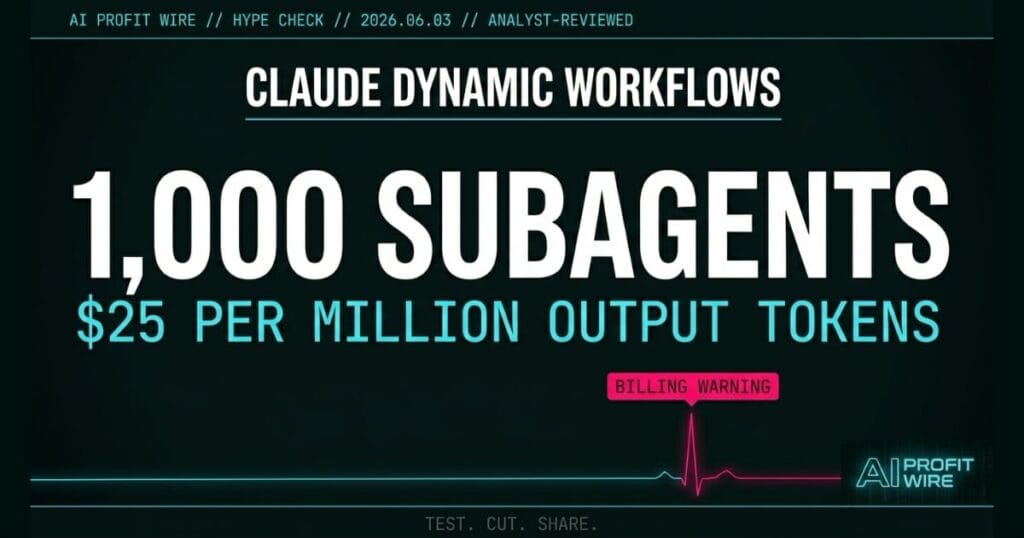
Enables parallel AI agent orchestration for complex tasks but carries substantially higher token costs per run with no published per-workflow cost estimate
What are Claude Dynamic Workflows and what changed in Claude Code?
Anthropic shipped Dynamic Workflows inside Claude Code as a research preview, available on all paid plans. The feature allows up to 1,000 total subagents per run with 16 running concurrently, breaking large complex tasks into parallel workstreams with built-in self-evaluation loops. Each subagent operates independently, planning, executing, and verifying its own output before results are consolidated. The feature connects to the Anthropic API, Bedrock, Vertex AI, and Microsoft Foundry at standard Opus 4.8 pricing, with Pro plans requiring manual enable via /config and Enterprise plans using admin opt-in by default. The capability closes a real gap in AI-assisted complex workflows, and the official billing warning inside the documentation is the part that requires attention before any deployment at scale.
What proof backs this signal?
Anthropic’s official Claude Code documentation confirms the 1,000 total subagent and 16 concurrent agent limits, designed explicitly to bound the cost of a runaway script and prevent uncontrolled resource use. Community reports from early users describe a 750,000-line codebase handled in days with a 99.8% test pass rate using parallel workflow runs, though these figures come from individual accounts rather than official Anthropic benchmarks. Anthropic’s own blog states directly that dynamic workflows can consume substantially more tokens than a typical Claude Code session, and recommends starting on a scoped task before scaling. The capability data comes from real deployments and the risk data comes from Anthropic itself, which is the combination that makes this signal worth reading before enabling.
Should small business owners care about Claude Dynamic Workflows?
If your business uses Claude Code for development, research, or any multi-step AI task, Dynamic Workflows changes what is possible at the execution layer. Tasks that previously required manual handoffs between sessions can now run as coordinated parallel workstreams with built-in quality verification. The /workflows view shows per-agent token usage in real time and allows stopping any run without losing completed work, which gives operators genuine cost visibility mid-run. You can track how this fits into broader AI agent deployment patterns in our latest signals report. The feature is production-ready for scoped tasks and the billing transparency tools are built in, but deploying at full scale without a test run first is how the token bill becomes the story instead of the output.
The Margin Obsession runs the same calculation every time a new AI capability ships. The demo shows 1,000 subagents completing a codebase migration in days. The invoice shows Opus 4.8 output tokens at $25 per million, multiplied across every parallel verification loop, every planning pass, every self-evaluation cycle running simultaneously across 16 concurrent agents. The demo never runs the workflow on a 500,000-token task. The margin does not survive the real task at that scale without a test run first. Anthropic published the warning in the documentation before anyone asked for it, which means the billing risk is both real and acknowledged at the source. The operators who read the documentation before they run the workflow are the ones whose margin survives the first production deployment.
Exact Founder Execution Steps
1. Enable Dynamic Workflows via /config on Pro plans or confirm admin opt-in on Enterprise before running any workflow.
2. Start with one scoped directory or a single bounded task to establish your baseline token spend before scaling to the full workload.
3. Open the /workflows view during the first run and monitor per-agent token usage in real time before committing to larger runs.
4. Route non-critical verification stages to cheaper models where the task does not require Opus 4.8 reasoning capability.
5. Compare total token spend against manual time cost before deciding whether to run the same workflow type at larger scale.
What is the move on Claude Dynamic Workflows?
Enable the feature on a Pro plan via /config, run one scoped task, and open the /workflows dashboard to read the per-agent token breakdown before committing to a full production run. At $25 per million output tokens on Opus 4.8 API pricing, a complex multi-stage run is not a rounding error on the monthly bill, and Anthropic’s own documentation is explicit about starting small before scaling. The parallel execution capability is real and the cost controls are built in, and the correct entry is one test run with the dashboard open before the workflow becomes a line item your finance team asks about.
Sources: Claude Code Documentation (Anthropic) | Anthropic Blog
