Significant potential to reduce administrative overhead and increase revenue capture for health-service providers by automating insurance claims and triage.
What is agentic AI in healthcare and why does it matter now?
Agentic AI moves beyond chatbots to autonomous workers. These systems handle end-to-end administrative tasks without constant human prompting. The shift to autonomous agency reduces the cost per exception in complex billing cycles.
What proof backs this signal?
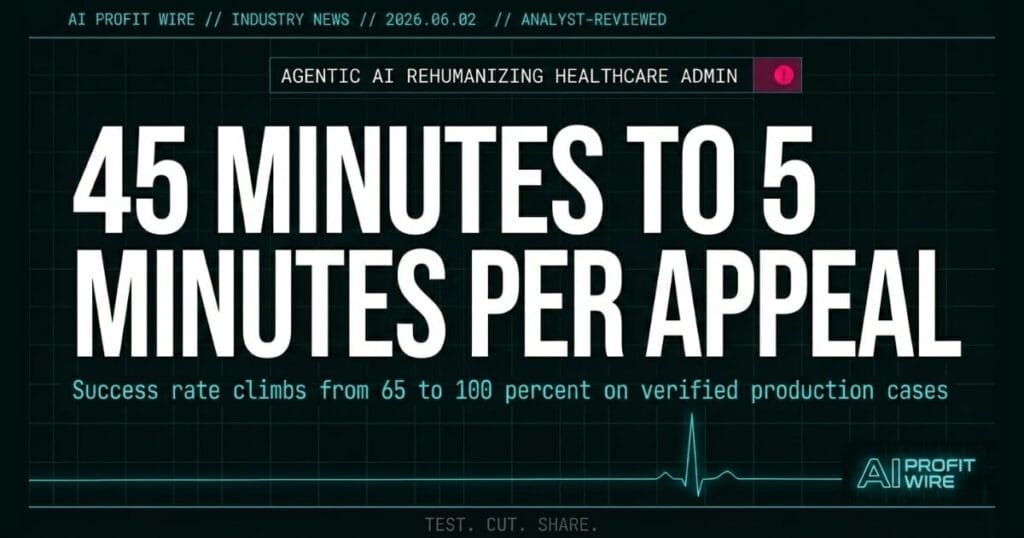
Hospital for Special Surgery implemented agentic AI for insurance appeals. Processing time dropped from 45 minutes to 5 minutes per appeal. Success rates increased from 65% to 100%. Replacing manual appeal workflows with agentic AI removes the human error that kills revenue capture.
How does agentic AI affect day-to-day operations?
Admin overhead shifts from a labor cost to a compute cost. Triage and claims processing happen in the background. This frees staff from the 40-minute trust gap often found in manual audits. Check recent signals for more on how agentic AI is impacting service sectors. Reducing administrative friction allows health-service providers to scale without increasing FTE counts.
Look at a P&L and you see the leak. You have 3 employees spending 40 hours a week fighting insurance companies for money you already earned. Every denial is a punch to the margin. You pay the salary, you pay the overhead, and you still lose 35% of the appeals because someone forgot a form. This is not a staffing problem. It is a workflow failure. Stalling on this transition means you are choosing to pay for inefficiency while your competitor captures every cent of their billables.
Should you act on this signal now?
The technology is moving from research to production in high-volume medical centers. While not a plug-and-play SMB tool yet, the ROI math is proven. Audit your manual administrative bottlenecks now to identify where autonomous agents can capture leaked revenue.
Source: MIT Tech Review
