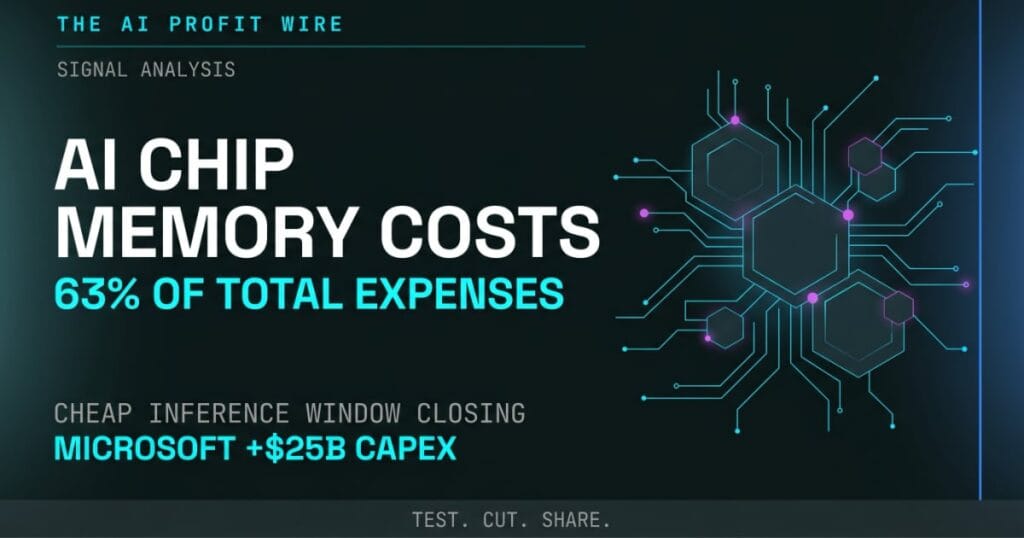
Rising hardware costs for AI providers may eventually lead to increased pricing for the AI API services that small businesses rely on.
What is memory cost scaling and why does it matter now?
Memory costs now account for 63% of total AI chip component expenses. This shift marks a transition where the memory subsystem, rather than the logic or compute units, drives the price of the hardware. This trend is driven by the massive data requirements of larger models, which force a heavier reliance on high bandwidth memory. The bottleneck for AI scaling has shifted from raw compute power to the cost of moving data, which makes memory the most expensive part of the machine.
What proof backs this signal?
Data from epoch.ai confirms that memory is the dominant expense in chip production. Major players like Microsoft and Meta are increasing their hardware budgets to account for these rising component costs. The evidence shows that as models grow, the memory requirements scale faster than the cost of the processing cores themselves. When the largest tech companies on earth have to adjust their spending to account for memory costs, the industry is facing a fundamental shift in how AI hardware is priced.
Should small business owners care about AI chip memory costs?
Small business owners should monitor this because hardware costs eventually dictate the price of AI API services. This fits a pattern seen repeatedly in the AI Profit Wire signal archive, where hardware constraints eventually trigger price adjustments for the end user. While current API prices are subsidized by venture capital or massive corporate budgets, those margins will shrink as memory costs climb. The current era of cheap inference is a temporary window that will close once the cost of memory forces providers to stop absorbing the hardware bill.
Software costs follow hardware costs like clockwork across every technology cycle. The data on memory is worth reading carefully because it predicts the coming price hikes, and the gap between “providers are absorbing this” and “operators are paying for this” is smaller than most people think. In my businesses, the goal is to build token-efficient workflows before the invoice changes, because the operators who wait until they see the spike on their billing dashboard are already six months behind. Microsoft alone attributes $25 billion of its FY2026 capex to higher component prices, and that money eventually moves downstream.
Should you act on this signal now?
The move now is to optimize token usage and reduce reliance on expensive long-context windows. Reducing the amount of data sent per request lowers the memory pressure on the provider and hedges against future price increases. Operators who build efficient prompt architectures now will be less exposed when the memory tax hits the user. Maximizing ROI per token today is the only hedge that costs nothing, and it works whether or not the price hike arrives on schedule.
Source: epoch.ai
