Verification costs scale non-linearly with AI output gains, creating net losses for operators without scalable validation. 10x output with 100x review time turns cheap AI into a liability. Specific: manual review fixes miscategorization that AI creates in minutes but takes hours to correct.
The Execution Bottleneck Is Gone. The Verification Bottleneck Is Here.
Today’s signals show a clear pattern across operator workflows:
- DeepSeek cut API prices 75 percent. Token costs dropped. Verification costs stayed flat.
- BNP Paribas partnered with Mistral AI. Human analysts cannot verify cyber threats at machine speed.
- Codex reorganizes Slack in minutes. Miscategorization takes hours to fix.
The constraint is no longer AI capability. The constraint is verification capacity.
What is the verification gap?
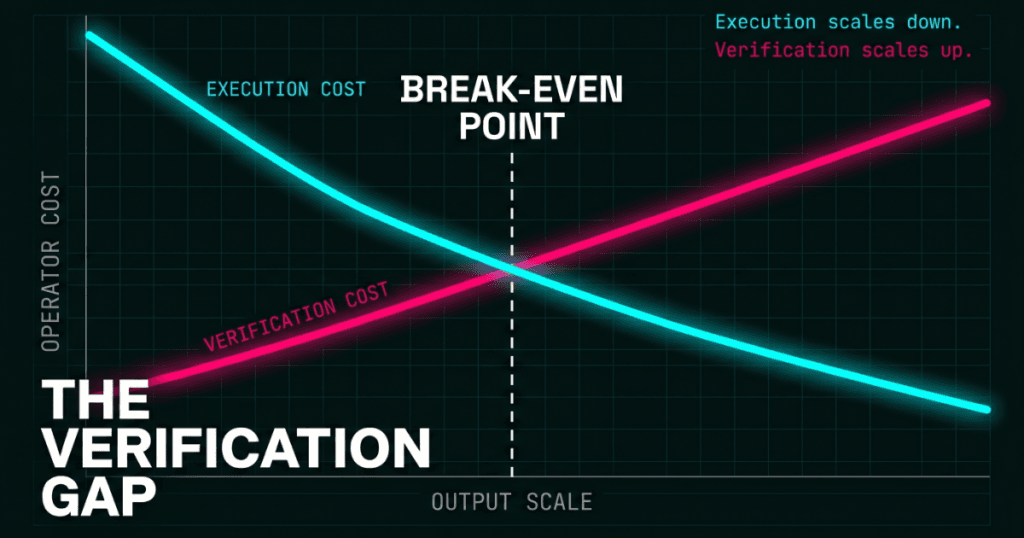
The verification gap is the difference between how fast AI can generate output and how fast humans can validate it. When inference costs drop but verification labor stays constant, the ROI math flips. Operators who optimize for cheap tokens without building verification systems end up paying more in review time than they save in automation.
What proof backs this pattern?
Three signals from today confirm the shift:
- DeepSeek’s permanent 75% price cut makes token costs negligible, but operators still need human review for quality control.
- BNP Paribas turning to Mistral AI for cyber defense because human analysts cannot verify threats at machine speed.
- Codex users reporting that AI reorganizes Slack in minutes, but miscategorization errors take hours to fix manually.
Should small business owners care about verification costs?
Yes. SMBs operate with leaner teams and cannot absorb verification debt at scale. When a solo operator automates customer support with AI, they save on labor but create a hidden cost: every AI-generated response requires review before sending. If review time exceeds the time saved, the automation loses money. The gap between enterprise verification budgets and SMB verification capacity is where operators get trapped.
Should you act on this signal now?
Map your verification capacity before scaling AI spend. Calculate your current review time per AI output. If you are spending more than 30 percent of saved time on verification, you are in scenario three (losing money). Build validation loops that scale: templates, checklists, automated quality gates. If your review process is manual, your automation ceiling is fixed.
The Operator Math
When AI output scales, review time does not scale linearly. Most operators miss this because they track token spend instead of validation labor.
- Output scales 10x, review time scales 1x: you win.
- Output scales 10x, review time scales 10x: you break even.
- Output scales 10x, review time scales 100x: you lose money.
Most small operators are in scenario three. They celebrate cheaper inference while verification debt compounds silently.
Where the Value Shifts
Inference is commoditizing. Verification, classification accuracy, and error recovery are staying expensive. This matches what institutional operators are already pricing into their AI budgets.
The arbitrage is simple: optimize for verification throughput, not token cost. Build validation loops that scale with output. If your review process is manual, your automation ceiling is fixed.
Source: The AI Profit Wire (Moe Sbaiti operator analysis)
Last Updated: May 26, 2026 | Signal Type: research
