Provides alternative infrastructure options for companies needing strict data control in Europe.
Who Invested in Mistral AI and How Much?
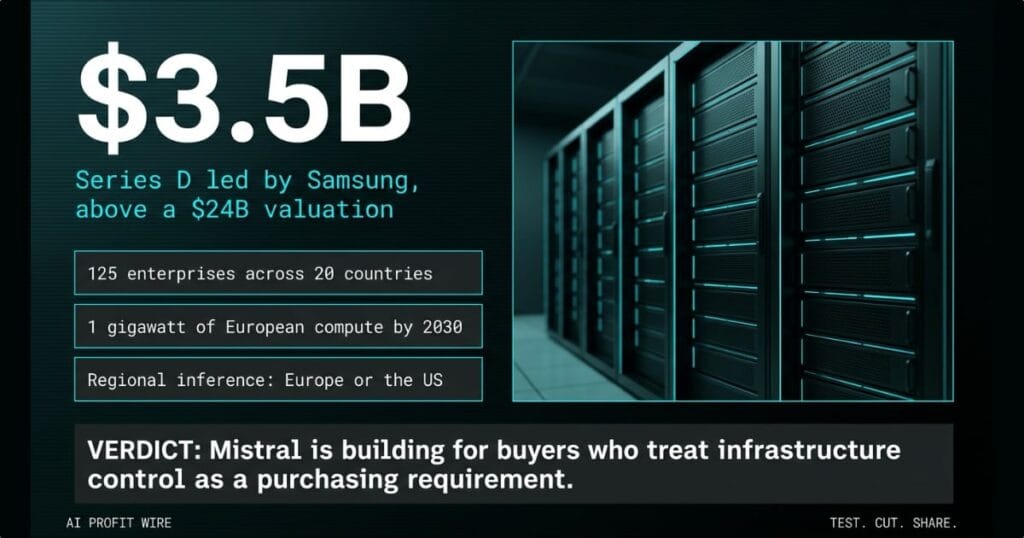
Mistral AI raised $3.5 billion in a Series D round that values the Paris-based company above $24 billion, the largest equity funding round for a private European tech company. Samsung Electronics led the round, with EQT’s Scaleup Europe Fund and existing investor PSG Equity as co-leads.
New money came in from Advent, BlackRock funds, and the Grand Duchy of Luxembourg, alongside participation from a16z, NVIDIA, Salesforce Ventures, and earlier backers. ASML led the prior Series C, so the cap table now carries two industrial giants with procurement departments of their own.
The company operates across 20 countries and supports more than 125 enterprises, including Airbus, ASML, and HSBC, per AI Business coverage of the round and Mistral’s own announcement.
This is infrastructure money, not a model-lab bet, and the investor list reads like a procurement pipeline.
What Are Mistral AI’s Actual User and Revenue Numbers?
The disclosed base is 125+ enterprises across 20 countries, with Airbus, ASML, and HSBC named in the announcement. What Mistral does not disclose is revenue, and the coverage is candid that named logos do not prove sovereignty drove those purchases.
The product surface behind the numbers is concrete. Regional inference endpoints that let customers choose European or U.S. processing reached general availability in August, alongside a Priority Tier in public preview that carries an uptime SLA for mission-critical workloads.
The stated compute plan runs to 1 gigawatt of European capacity by 2030, and third-party open models already run on the same infrastructure, starting with Z.ai’s GLM-5.2. That widens the catalog beyond Mistral’s own releases without fragmenting where the workloads run.
The traction is real, early, and on the record: the customers and the infrastructure commitments are both named.
How Is Mistral Different From OpenAI for Enterprise Buyers?
On raw model capability, the coverage is direct: Mistral’s resources remain smaller than the leading U.S. frontier labs, which makes competing on model development alone difficult. Mistral’s counter is the open-weight stack, where customers can adapt models, host them on their own infrastructure, and switch providers when terms, pricing, or access change.
Conventional procurement optimizes for performance per dollar on the vendor’s infrastructure. Mistral asks buyers to add a fifth criterion, control over where processing happens and who owns the stack, and Jeet Pattanaik of Glokal AI told AI Business that open weights more often act as a tiebreaker than the primary driver.
The exception is where the money moves: regulated data and always-on systems, where control becomes a requirement first and performance gets compared only among the models that clear that bar. Cognizant’s Akash Thakur put the shift in one line: data location is becoming a buying criterion rather than a compliance concern.
Buy the U.S. labs for frontier capability, and buy Mistral when the deployment itself is the compliance surface.
The copier lease audit lands on the owner’s desk in year 3: the per-click rate crept up, the service window slipped, and the exit clause never moved. Renting was cheaper than buying, until the month the machine became the office’s single point of failure and the vendor held every card.
Every owner who has lived through that audit understands the Mistral pitch without a single slide about models. Rented capability is fast and cheap until the vendor’s roadmap, pricing, or geography stops matching yours, and then the exit becomes the part of the deal you care about.
Open weights are the exit, and the $3.5 billion behind them turns a sovereignty pitch into infrastructure you can inspect in person. The bet is that enough enterprises have hit their own year-3 audit moment with AI.
What Does the Mistral Raise Mean If You Already Use Open-Weight Models?
If you already self-host open-weight models, the round means the vendor behind those weights now has the balance sheet to sell you the parts you don’t want to run yourself: regional inference endpoints, an SLA-backed tier, and hosted third-party models under the same controls.
Vendor shifts at this scale land in the infrastructure layer first, which is why the signals desk tracks them next to the tool-level changes that hit a small stack faster. The pattern worth watching is portability becoming a standing procurement line rather than a one-time migration project.
If you sell into Europe or serve companies that do, the coverage’s warning lands on you: buyers are starting to ask where AI runs and how workloads move, and U.S. vendors with European subsidiaries will feel it first.
The practical read is portability: open weights give you the exit, and this round funds the infrastructure you can exit into.
What Should You Do About Mistral’s $3.5B Raise?
Audit your current AI vendors on 1 question, in writing: where is our data processed, and under which jurisdiction. Any vendor that cannot answer carries that risk on your books, not theirs.
Add data location and portability to the next procurement review if you handle regulated data, because control is moving from compliance checkbox to buying criterion. Tag the workloads where a performance gap costs real money, and leave the rest free to chase benchmarks.
Then watch the requirement the way you watch a rate change on a lease. The moment data locality reaches your customers’ contracts, the vendor list narrows on its own, and Mistral is the vendor positioned to catch it.
Nothing in this round demands action this week, and everything in it rewards having the data-location answer ready before the next procurement cycle opens.
Source: AI Business
